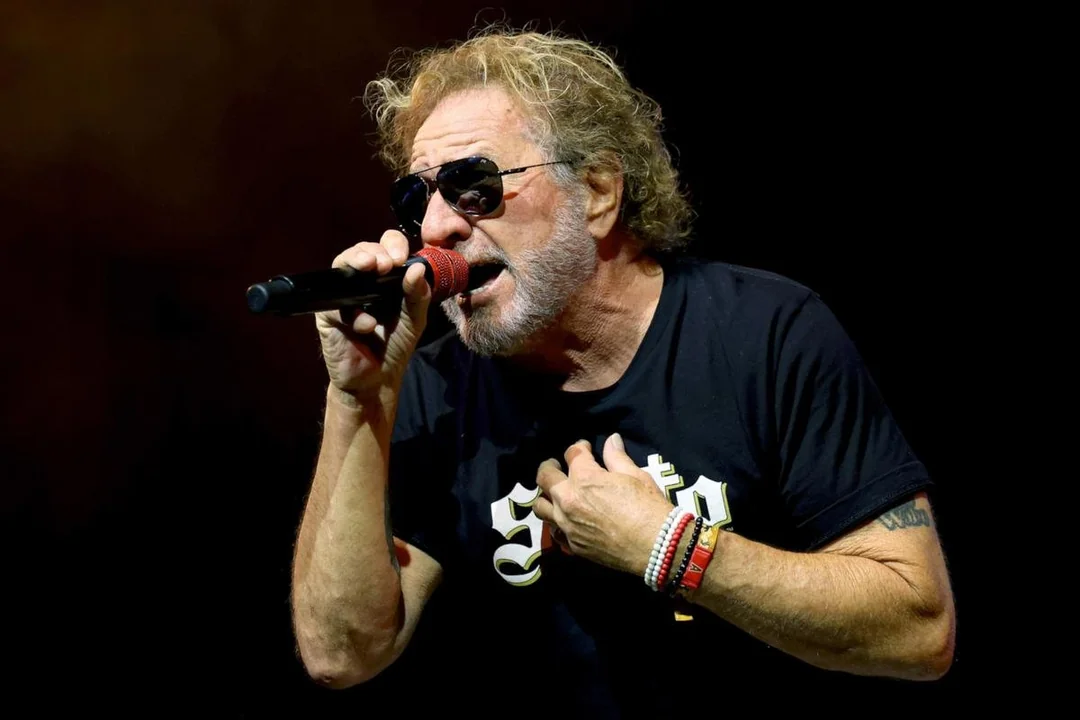
Sammy Hagar’s top chart hits tell a stranger, richer story than the usual “party guy joins Van Halen” shorthand. Pull the needle back across the vinyl and you hear a career built in stages: the hungry Montrose kid, the solo Red Rocker grinding his way onto FM radio, the guy who walked into Eddie Van Halen’s studio in 1985 and somehow helped take Van Halen to No. 1 albums. The charts don’t explain everything. They never do. But they do show something fans sometimes forget: Sammy wasn’t just loud. He was commercially durable, weirdly adaptable, and better at writing radio-ready rock than his critics ever wanted to admit.
Before the Big Numbers: Montrose Built the Foundation
The charts didn’t immediately bow down to Sammy Hagar. That’s important. His first major blast came with Montrose’s 1973 debut, a record that later musicians treated like a secret hard-rock manual even if mainstream radio didn’t turn every track into a pop hit. “Bad Motor Scooter” and “Rock Candy” weren’t Hot 100 monsters, but they mattered. Big time.
Here’s the thing: chart success often arrives after the identity is already formed. With Montrose, Hagar learned how to ride a riff without crowding it, how to sound young and dangerous without sounding fake. Ronnie Montrose gave him the heavy machinery. Sammy brought the ignition.
Most fans don’t realize how much that album echoed through later American hard rock. Eddie Van Halen admired Montrose, and you can hear why: the economy, the swagger, the idea that one guitar could fill a room like a jet engine. Before Sammy had hits, he had credibility. That would matter later, especially when he stepped into the most controversial frontman job in rock.
“Your Love Is Driving Me Crazy”: Sammy Crashes the Pop Top 20
Sammy’s first real pop-chart breakthrough came with “Your Love Is Driving Me Crazy,” from 1982’s Three Lock Box. It peaked at No. 13 on the Billboard Hot 100 in early 1983, making it his highest-charting solo single. For a guy often remembered as a hard-rock lifer, that’s a fascinating detail. He didn’t need Van Halen to prove he could write a hit. He had already done it. ([Wikipedia][1])
Truth be told, the song is slicker than some of his heavier fans might prefer. It has that early-’80s radio polish, the kind of chorus built to survive between Journey and Loverboy on a car stereo. But Sammy doesn’t disappear into the production. His voice still has grit. Still has heat.
You could argue this is where the Red Rocker learned one of his most valuable tricks: make the hook big enough for radio, but keep the vocal rough enough for the parking lot. That balance would define many of Sammy Hagar songs for the next decade.
“I Can’t Drive 55”: The Solo Hit That Became a Cultural Tattoo
“I Can’t Drive 55” only reached No. 26 on the Billboard Hot 100, which almost feels wrong when you consider how massive it became in American rock memory. But that’s the funny thing about charts. They measure a moment. They don’t always measure afterlife. Released as the lead single from 1984’s VOA, the song also hit No. 9 on Billboard’s Top Rock Tracks chart and became Hagar’s signature solo anthem. ([Wikipedia][2])
The origin story is pure Sammy: a speeding ticket near Albany, New York, during the era of the national 55 mph speed limit, and suddenly frustration turns into a chorus every lead-footed American understands. The video did the rest — the Ferrari, the courtroom chaos, the yellow jumpsuit, the whole MTV-era cartoon of rebellion.
To be fair, some critics treat it like a novelty. I don’t buy that. The riff has teeth, and the sentiment is bigger than traffic law. It’s about refusing to shrink your life down to somebody else’s posted limit. That’s why it still shows up at races, car shows, and backyard parties decades later.
The Van Halen Gamble: “Why Can’t This Be Love” Goes Top 3
When Van Halen released “Why Can’t This Be Love” in March 1986, the pressure was ridiculous. David Lee Roth was gone. Sammy Hagar was the new guy. Fans were waiting with arms folded. And instead of trying to recreate “Panama,” the band led with a keyboard-driven pop-rock single. Risky? Absolutely. Smart? History says yes.
“Why Can’t This Be Love” climbed to No. 3 on the Billboard Hot 100 and became the first public proof that the new lineup could not only survive, but compete at the highest level. It also reached No. 1 on the Cash Box Top 100 and became a Top 10 hit in several countries, including the U.K., Australia, and Germany. ([Wikipedia][3])
What’s interesting is how the song reframed Van Halen overnight. Roth-era Van Halen was danger, comedy, lust, and California flash. Hagar-era Van Halen had more open emotion, more melodic reach, and a different kind of radio power. The Hagar vs Roth debate starts here for a reason. This wasn’t a replacement. It was a reinvention.
“Dreams” and “Love Walks In”: The Emotional Hits That Changed the Band’s Shape
“Dreams” and “Love Walks In” both peaked at No. 22 on the Hot 100 in 1986, and together they tell you almost everything about why 5150 worked. These weren’t just singles. They were statements. Van Halen could still rock, sure, but now they could soar, ache, and reach for something almost spiritual without losing Eddie Van Halen’s fingerprints. ([Music Charts Archive][4])
“Dreams” is the bigger emotional rocket. Sammy sings like he’s trying to punch a hole through the sky, and the band follows him upward. “Love Walks In” is stranger, softer, more mystical — the kind of song Roth-era Van Halen never would have made, which is exactly why it matters.
Most fans believe 5150 changed Van Halen’s commercial future. They’re right. The album became the band’s first No. 1 album on the Billboard 200, and these singles helped make the new era feel less like damage control and more like destiny. In many ways, Sammy’s chart success with Van Halen began by proving sincerity could sell.
“When It’s Love”: The Power Ballad That Went All the Way to No. 5
By 1988, the shock had worn off. Sammy was no longer just “the new singer.” He was the voice of a hugely successful Van Halen lineup. Then came “When It’s Love,” from OU812, and the band landed one of its biggest Hagar-era singles. The song peaked at No. 5 on the Billboard Hot 100 and hit No. 1 on Billboard’s Mainstream Rock chart, becoming Van Halen’s third and final Top 10 pop hit. ([Wikipedia][5])
Here’s the thing: “When It’s Love” is polished almost to a shine. If you miss the street-corner sleaze of early Van Halen, this is probably where you start complaining. Fair enough. But the song works because Sammy commits completely. He doesn’t sing romance like a costume. He sings it like a grown man trying to name something real.
And Eddie? He plays with restraint, which may be the most underrated part. The guitar doesn’t dominate the song. It supports it. That was the new Van Halen bargain: less danger sometimes, more reach.
“Finish What Ya Started” and the Groove Side of Chart Success
“Finish What Ya Started” peaked at No. 13 on the Hot 100 in 1988, and it remains one of the coolest curveballs in the Van Hagar catalog. No bombast. No power-ballad fireworks. Just a clean, sly, almost country-funk groove that proved Eddie’s rhythm playing could seduce as easily as it could detonate. ([Music Charts Archive][4])
The song reportedly came together late in the OU812 process, and it sounds that way in the best sense — loose, late-night, unforced. Sammy doesn’t oversing. He talks, teases, leans into the pocket. For a band famous for velocity, this was Van Halen discovering the power of restraint.
On the other hand, some fans never knew what to do with it. Was it hard rock? Pop? Barroom shuffle? Maybe all three. That ambiguity helped it age well. “Finish What Ya Started” is not the loudest of Sammy Hagar’s top chart hits, but it may be one of the most musically relaxed. It swings. Van Halen didn’t always swing in the Hagar era, but here they absolutely did.
“Black and Blue,” “Feels So Good,” and the Radio Machine Keeps Rolling
Not every hit becomes a permanent classic-rock monument. “Black and Blue” peaked at No. 34 in 1988, while “Feels So Good” reached No. 35 in 1989. Those numbers may not scream immortality, but they show how strong the Van Hagar radio machine was during the late ’80s. The band could send very different songs into the Top 40 and still sound like itself. ([Music Charts Archive][4])
“Black and Blue” is the tougher one, a bluesy hard-rock strut with enough grit to remind skeptical fans that Sammy had not turned Van Halen into a soft-rock act. “Feels So Good,” by contrast, is all bright keyboards and open-hearted optimism. It is very much of its era. No apology.
If you think about it, those two singles show the range that made the Hagar years commercially powerful. The band could be physical, romantic, glossy, or playful. Critics could grumble. Radio kept answering the phone.
“Top of the World” and the Last Big Arena Smile
“Top of the World” reached No. 27 on the Hot 100 in 1991, but its emotional footprint feels larger. Coming from For Unlawful Carnal Knowledge, it arrived during a heavier Van Halen period, after the band had pulled back from some of the keyboard gloss and returned to a more guitar-forward attack. The album debuted at No. 1 and later won a Grammy for Best Hard Rock Performance, giving the Hagar era a serious credibility boost. ([Music Charts Archive][4])
The song itself is pure lift. Eddie’s riff nods back to the ending of “Jump,” which gives it a subtle bridge between eras. Sammy sounds triumphant, almost sunlit. Yet time has made the track bittersweet. In 1991, grunge was about to change American rock’s center of gravity. Van Halen was still standing tall, but the weather was shifting.
That’s why “Top of the World” still hits. It captures the summit before the clouds roll in.
“Right Now”: The Hit That Became a Cultural Moment
“Right Now” peaked at No. 55 on the Hot 100 in 1992, which is almost laughably modest compared with its cultural reach. The video won major MTV attention, the piano riff became instantly recognizable, and the song eventually lived far beyond its chart position through sports broadcasts, commercials, and public-event montages. ([Music Charts Archive][4])
This is where chart talk gets tricky. Was “Right Now” one of Sammy’s biggest pop hits by peak position? No. Was it one of the most important Hagar-era Van Halen songs? Absolutely.
The song’s power comes from its seriousness. No wink. No party-boy smirk. Sammy delivers the lyric like a challenge, and Eddie’s arrangement gives it weight without drowning it in melodrama. Some old-school fans still think it’s too message-heavy. Maybe. But it gave Van Halen something rare: a song that felt like a public statement, not just a single.
In my opinion, “Right Now” is the chart underachiever that became a legacy giant.
“Can’t Stop Lovin’ You”: The Final Top 40 Goodbye
By 1995’s Balance, the Hagar-era Van Halen story was nearing its final act, even if fans didn’t know exactly how messy things would get. “Can’t Stop Lovin’ You” became the band’s last U.S. Top 40 hit, peaking at No. 30 on the Billboard Hot 100. That fact alone gives it a strange emotional weight. ([Music Charts Archive][4])
The song is clean, melodic, and openly romantic. Some fans find it too safe. I get it. But there’s something touching about hearing Van Halen still reaching for warmth near the end of that lineup’s run. The title nods toward Ray Charles’ “I Can’t Stop Loving You,” and Sammy even tips his hat to Ray in the lyric, giving the track a little old-school soul beneath the arena polish.
The story gets complicated here because Balance had darker, heavier material too. But radio chose the heart. That says a lot about what Sammy brought to Van Halen: emotional accessibility, for better and occasionally for worse.
What the Charts Really Say About Sammy Hagar
The numbers make one thing clear: Sammy Hagar was not just a lucky passenger in Van Halen’s machine. His solo career had already produced real hits, including “Your Love Is Driving Me Crazy” and “I Can’t Drive 55,” before he ever stepped into 5150. Then, with Van Halen, he helped deliver a run of major singles across 5150, OU812, For Unlawful Carnal Knowledge, and Balance.
That doesn’t end the Hagar vs Roth argument. Nothing will. Roth had the original magic, the danger, the grin, the mythology. Sammy had range, durability, and a voice built for both hard rock and radio emotion. Different weapons. Different wars.
What Sammy Hagar’s top chart hits reveal is not that one era was better. It’s that the Hagar era mattered commercially and culturally in ways the skeptics can’t erase. The songs reached people. Millions of them. And many stayed.
The Hit Parade Still Has Smoke Coming Off It
Charts are cold little machines, but the memories attached to them are anything but cold. Somebody heard “Why Can’t This Be Love” in 1986 and decided to give the new guy a chance. Somebody heard “When It’s Love” at prom, or in a Camaro, or during a late-night drive after a breakup. Somebody still hears “I Can’t Drive 55” and instinctively presses a little harder on the gas.
That’s the real story behind Sammy Hagar’s top chart hits. Not just positions, peaks, and release dates. A career that kept finding fresh ways to connect — with rock fans, with radio, with arenas full of people who wanted the chorus bigger than the problem. The Red Rocker may never win every argument. But put the hits on loud, and he still wins plenty of rooms.